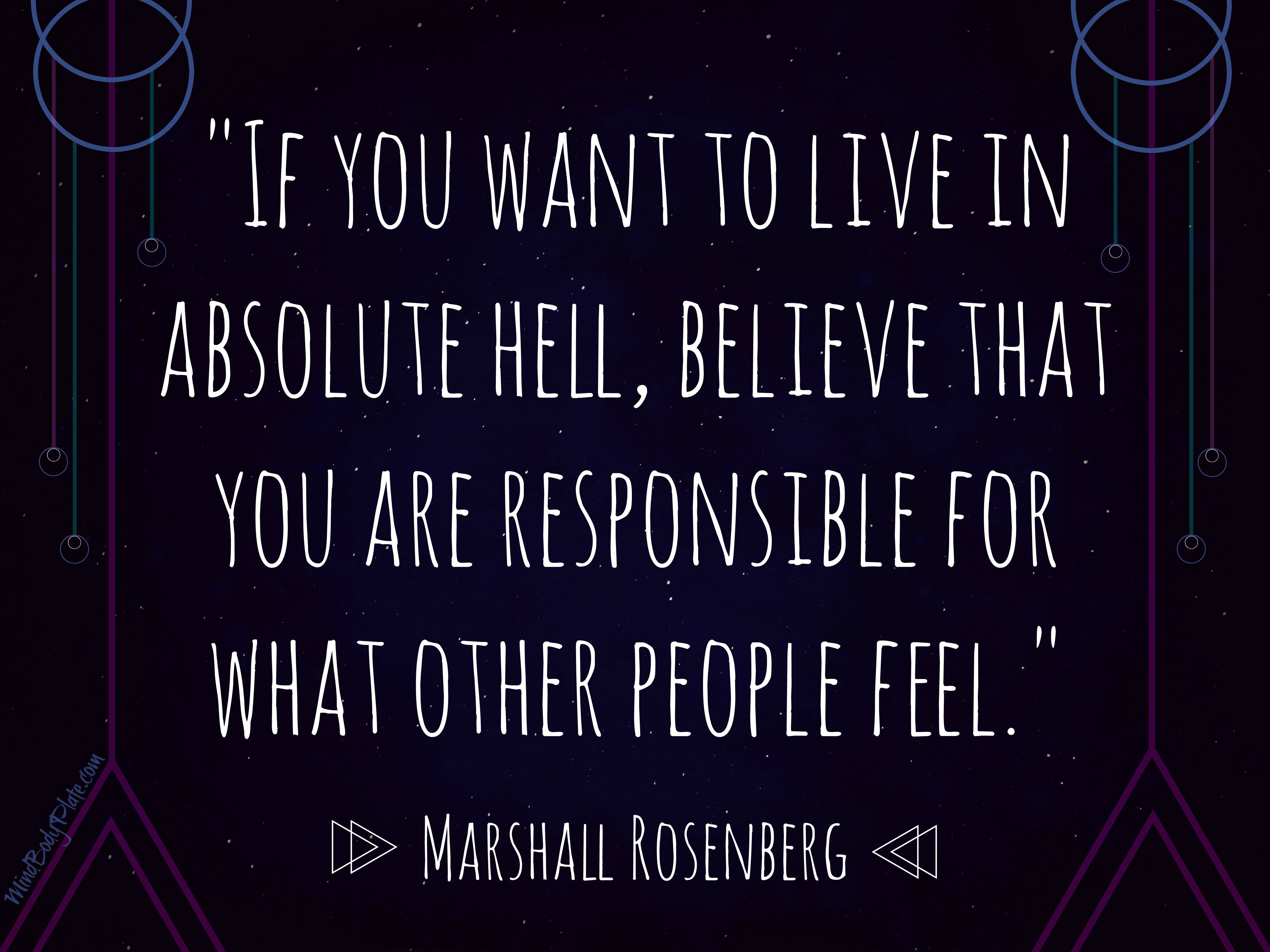
“Every criticism, judgment, diagnosis, and expression of anger is the tragic expression of an unmet need.”
~ Marshall Rosenberg


“But I say unto you, Love your enemies…”
“…Thou shalt love thy neighbour as thyself.”
“Enemy images are fixed, rigid ideas we have about others.”

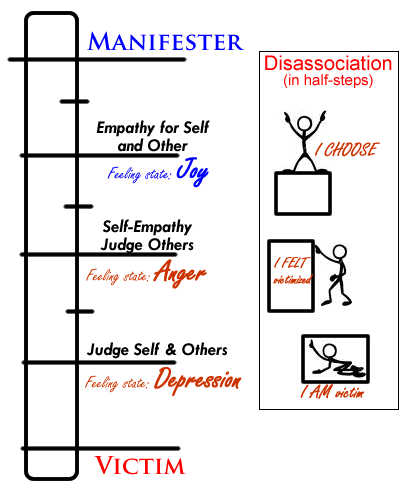
The Four Stages of Awareness: Working with Enemy Images
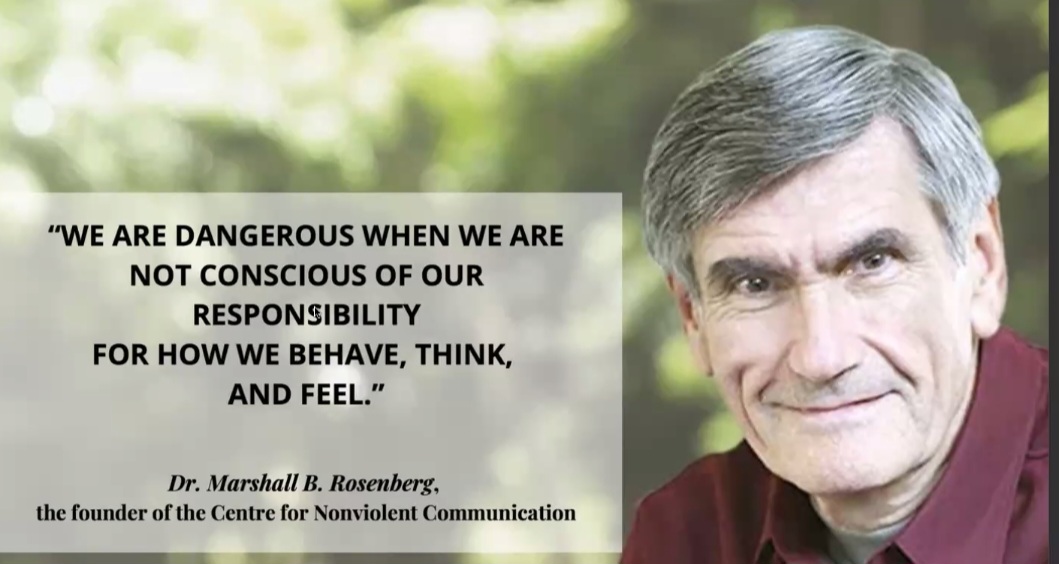
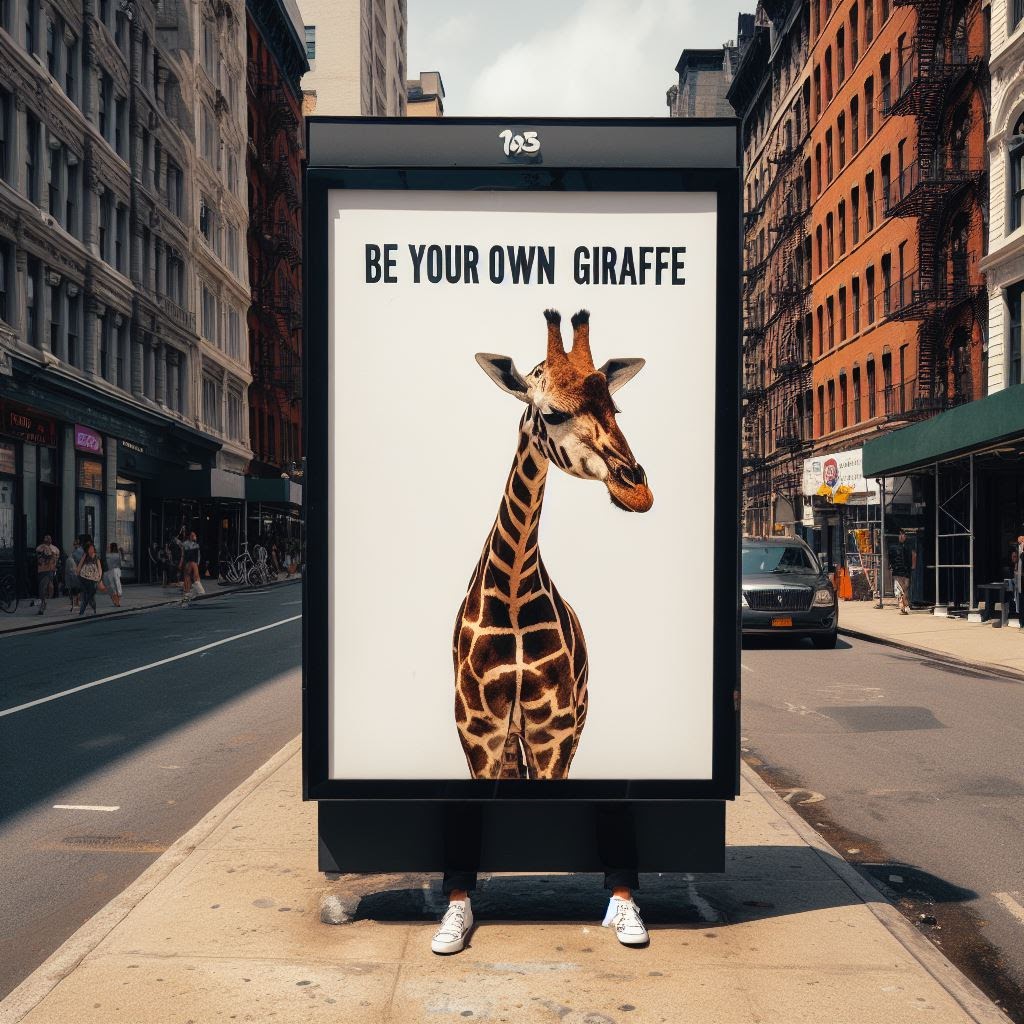
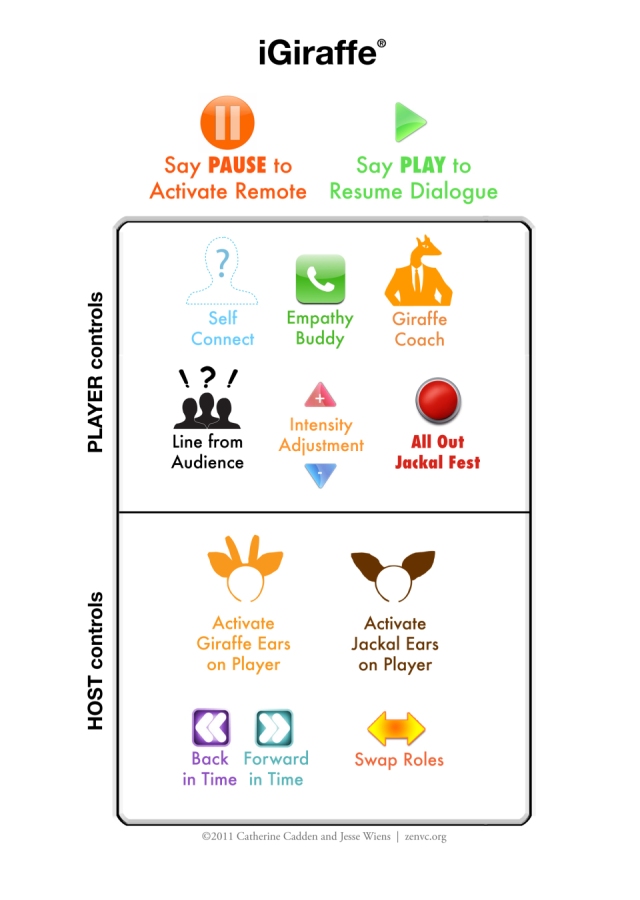
Origin Story of Jackal/Giraffe
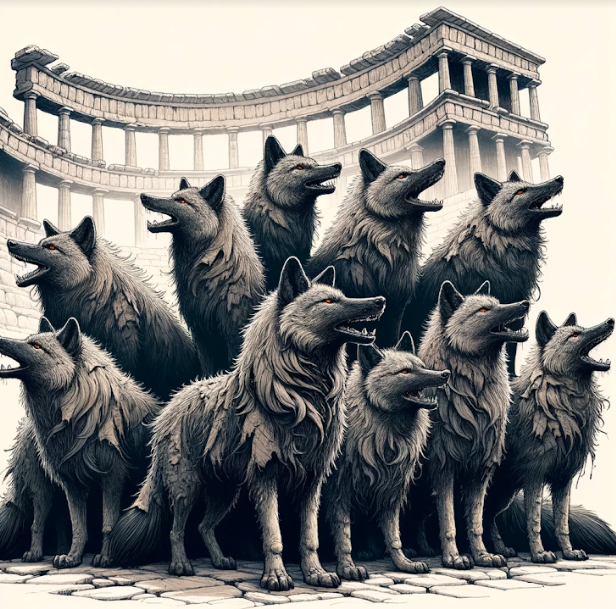
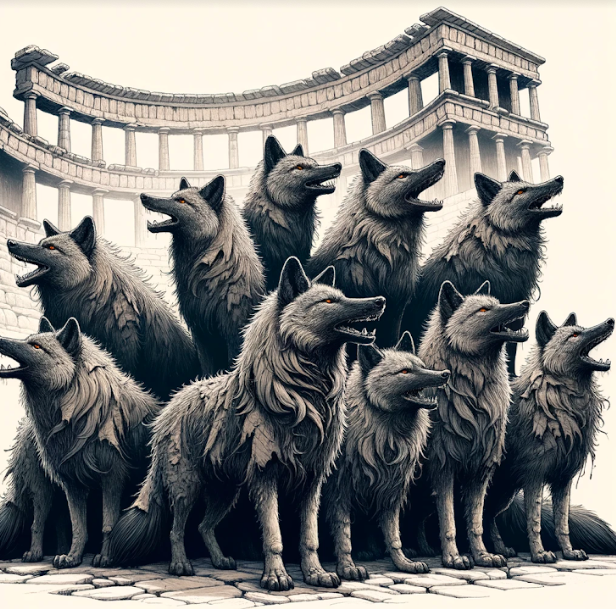
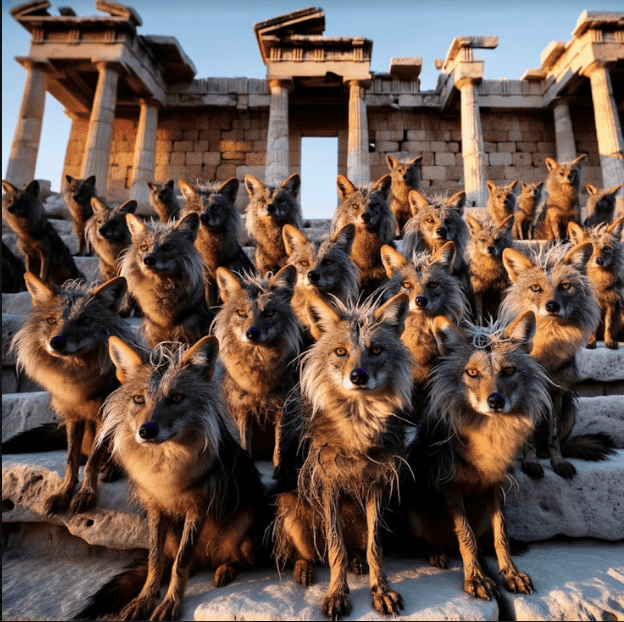
The Narrative Commentary of Our “Jackal Chorus” (akin to a Greek chorus)
Why Success Requires Two States of Mind — Mind Body Literacy
Excerpt: “…success isn’t about locking into a single state of mind. It’s about becoming comfortable moving between two very different states — especially when you’re exhausted and under strain…
The SEAL’s insight suggests a different approach: train for the oscillation, not just the ideal.”

“Neurosis as the manure of bodhi.“

In The Myth of Freedom and the Way of Meditation (Chögyam Trungpa, 1976), there’s a section where he writes:
“So meditation is a way of churning out the neuroses of mind and using them as part of our practice. Like manure, we do not throw our neuroses away, but we spread them on our garden; they become part of our richness.”


“One must step out of spiritual materialism” ~ Trungpa Rinpoche
How To Transform Enemy Images – Dr. Yvette Erasmus
see also:
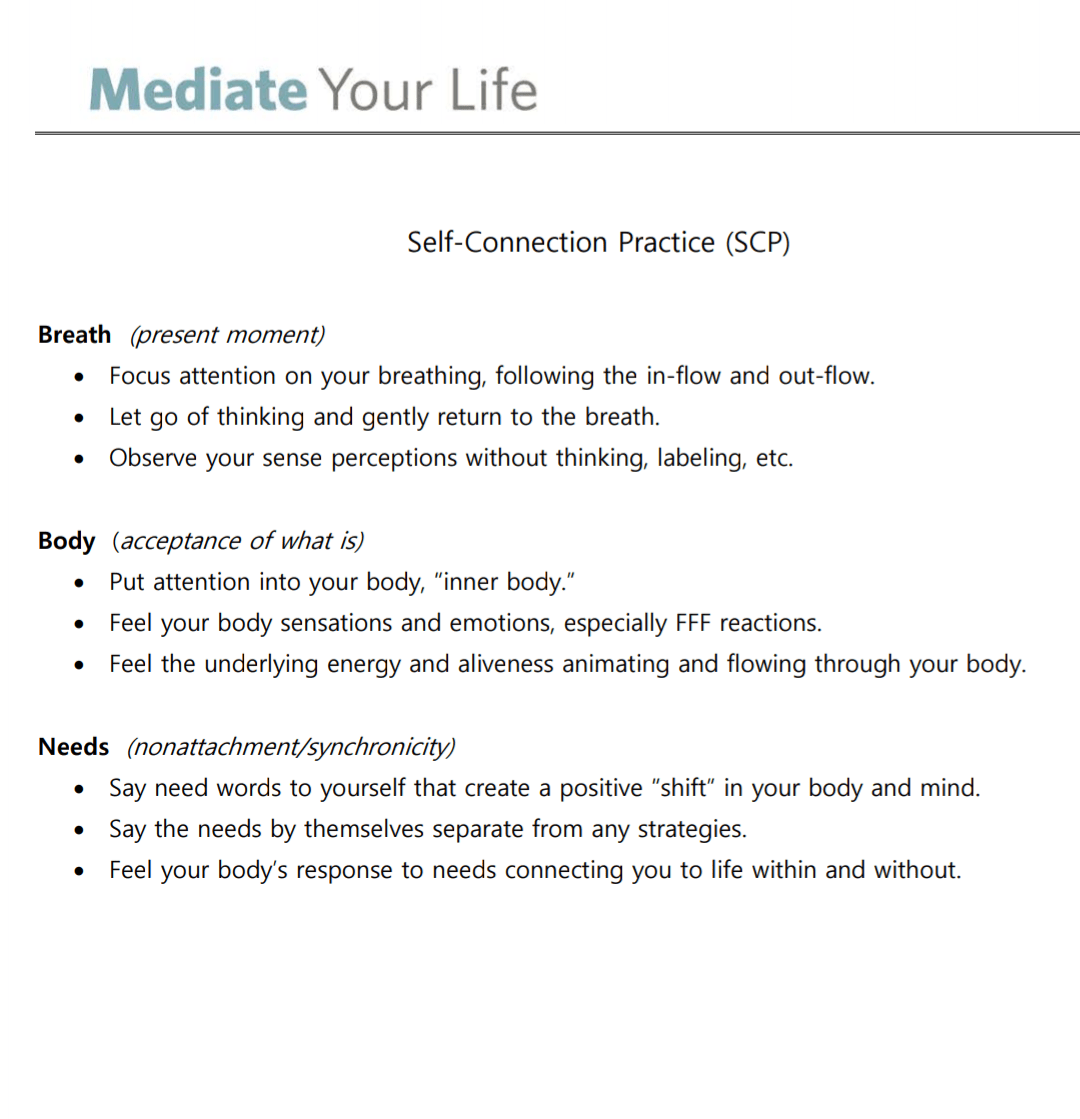
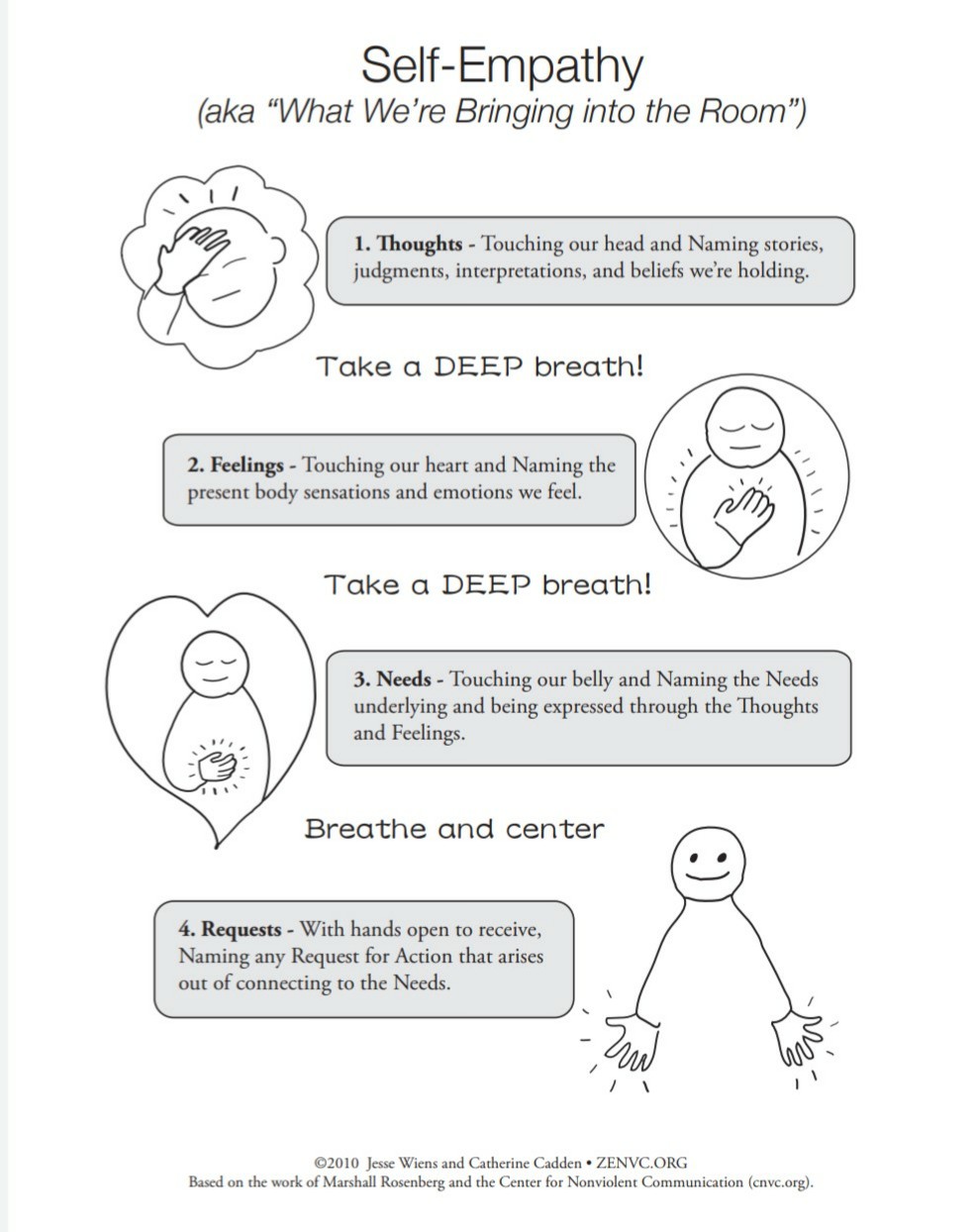
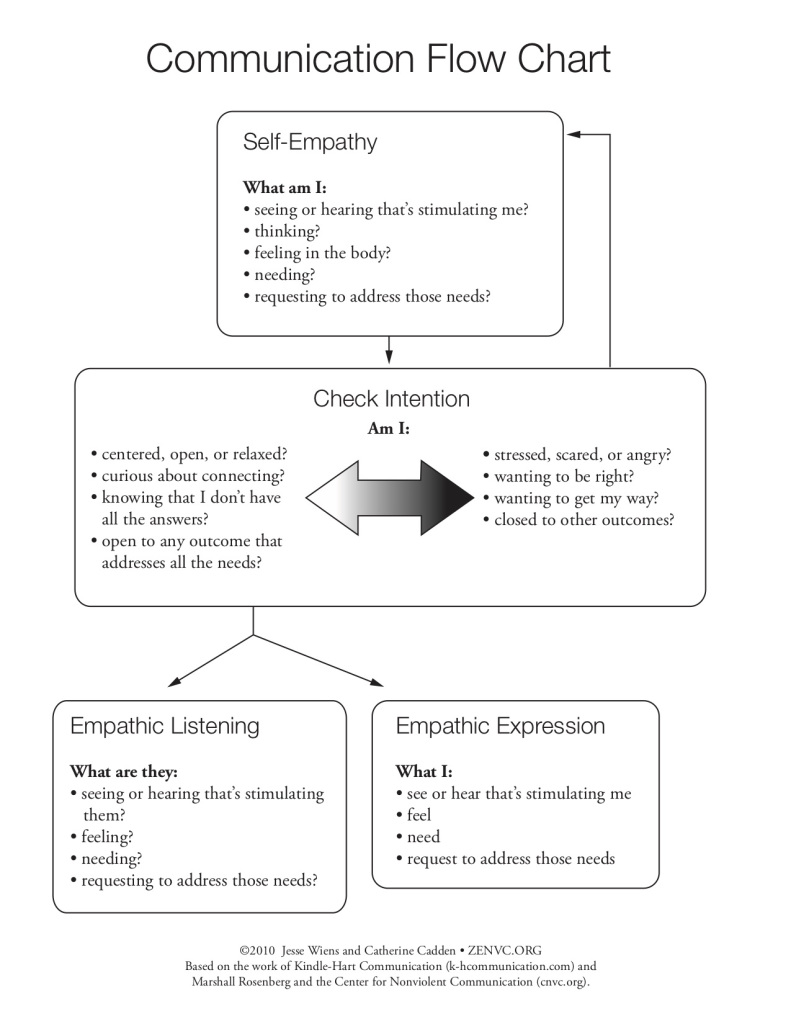
Self-Connection processes such as OFNR, Breath/Body/Need & the Mourning/Beauty of Needs
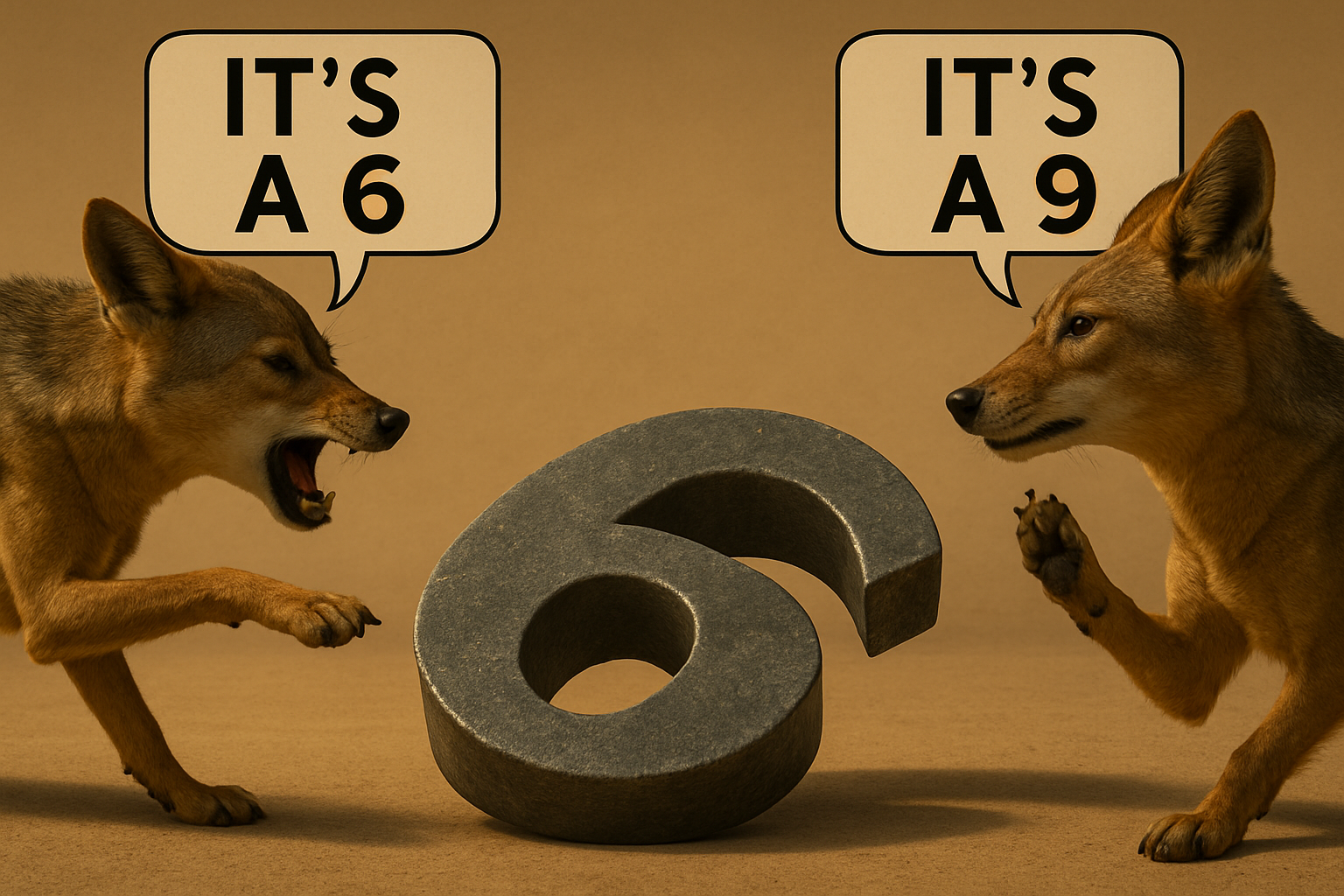
Can you perceive / understand another’s “6”, despite your disagreement and unwavering sense that it’s actually a “9”?
see also: NVC Mediation
Fielding another’s enemy-imagery, of us — by mirroring — towards side-stepping [projective] hooks
“True forgiveness is not about condoning or forgetting; it’s about releasing ourselves from the burden of resentment and finding peace within.”
~ Marshall Rosenberg


Enemy Imagery Process (EIP) Handouts [PDFs]:
Working with Enemy Images
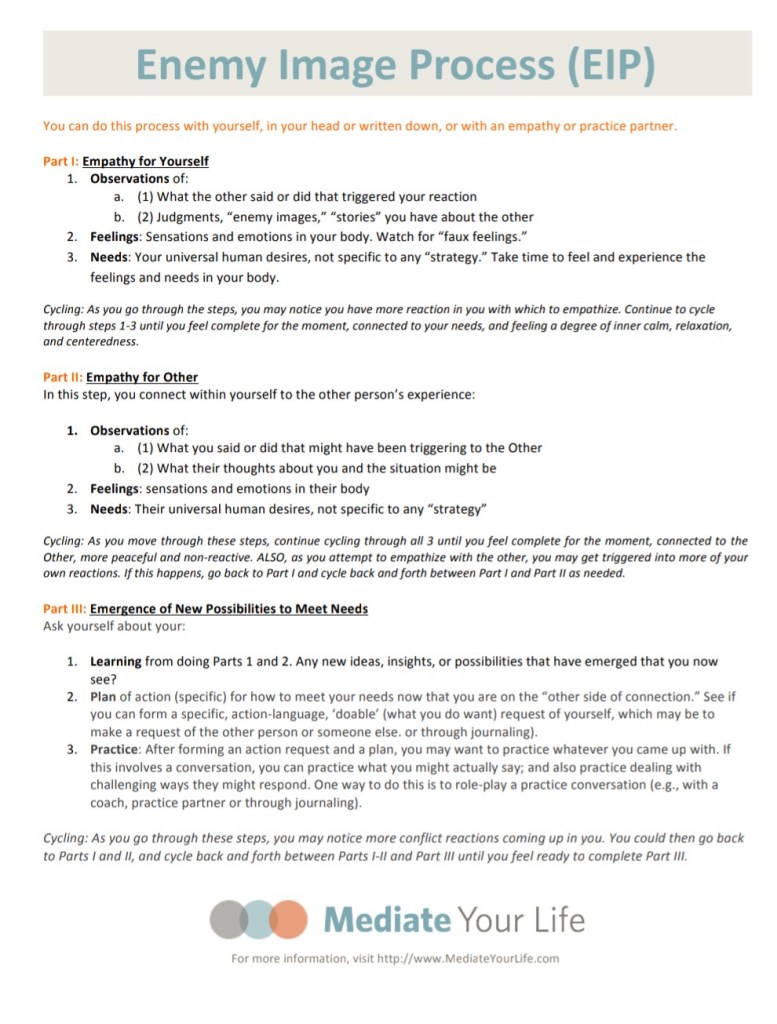
Enemy Image Process
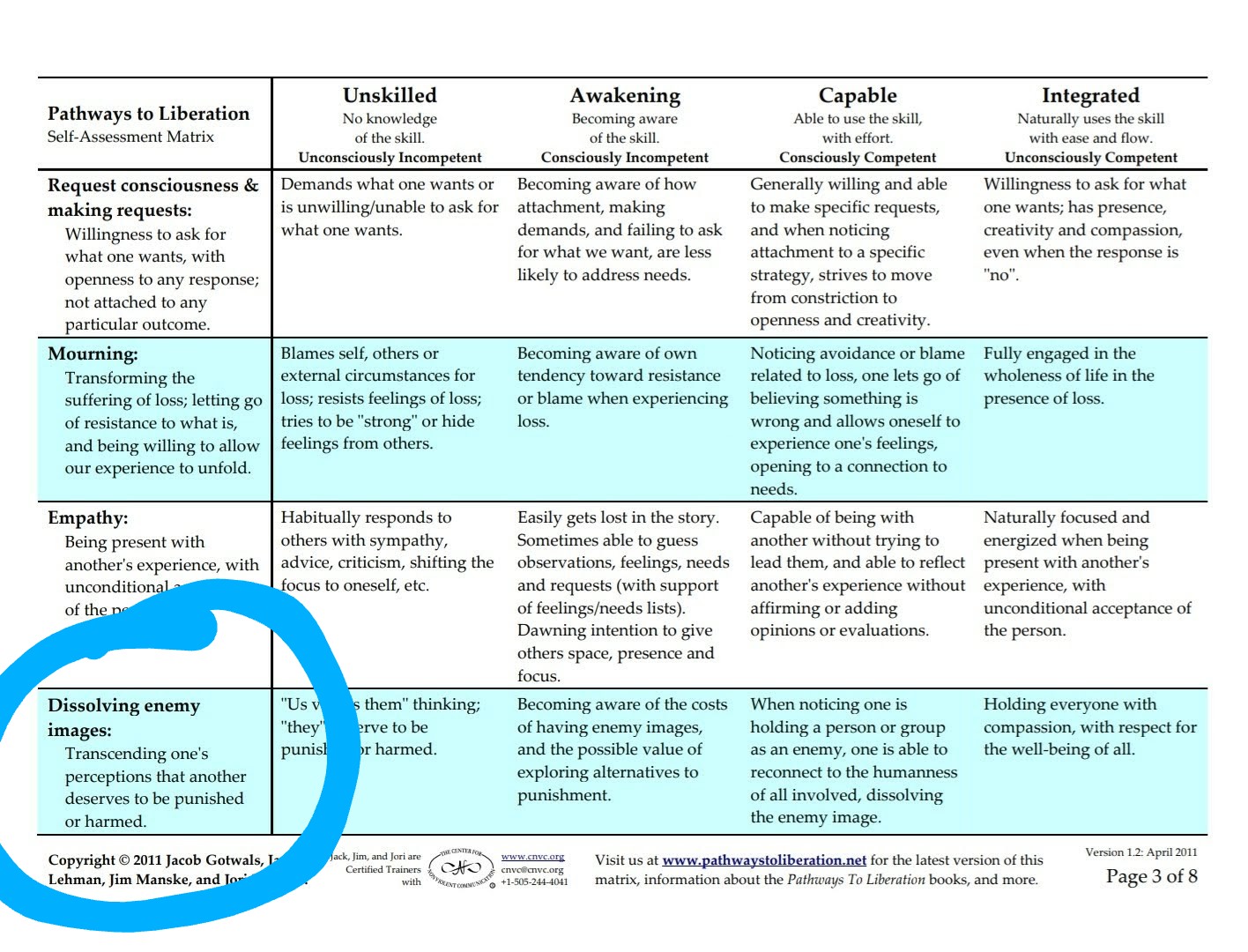
Dissolving Enemy Images

“Judgments of others contribute to self-fulfilling prophecies.”
~ Marshall Rosenberg
“‘Love Your Neighbor as Thyself’ means that your neighbor is yourself, and this recognition of oneness is love.” ~ Eckhart Tolle
More as to working with enemy-imagery here.

NVC Resources on Enemy Images – Nonviolent Communication

Intensity Practice Handout
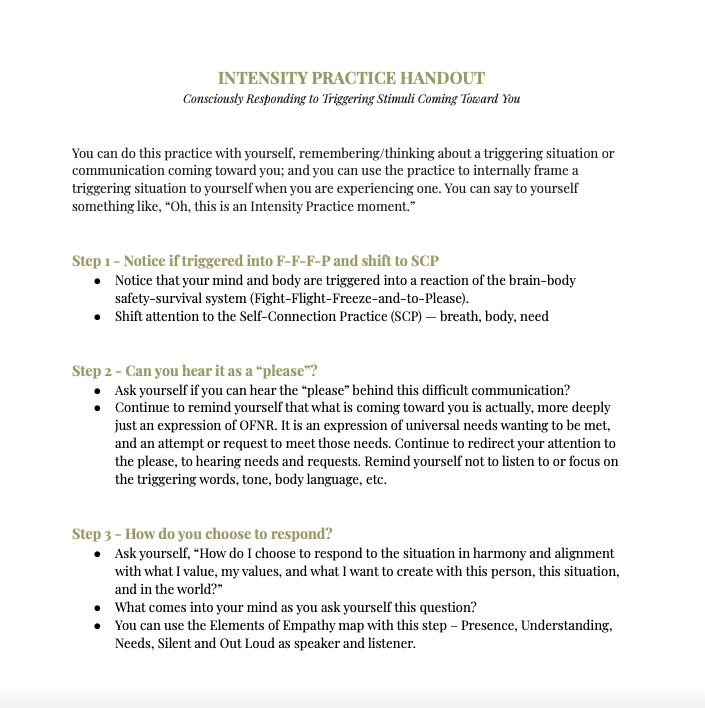
Intensity-Practice-Handout [PDF]

“Everything that irritates us about others can lead us to an understanding about ourselves.”
~ Carl Jung
See also: Peace/Love/Joy (Self-Connection Practice)
Newt Bailey (@nmbailey) — Excerpt: “I have a sense that 90% of Nonviolent Communication is about ‘Self-Connection.’ When using this expression, I’m referring to the practice or process that lives at the root of Inbal Kashtan’s Tree of Life diagram…” (continues)
“Our survival as a species depends on our ability to recognize that our well-being and the well-being of others are in fact one and the same.”
~ Marshall B. Rosenberg, “Practical Spirituality”

Self-Trust: Our Ability to Respond
“One of the things I love about the relational practice of nonviolence is how it frees me up to field a much wider range of responses from other people, without losing access to my compassion, courage or grounded clarity.” (continues)

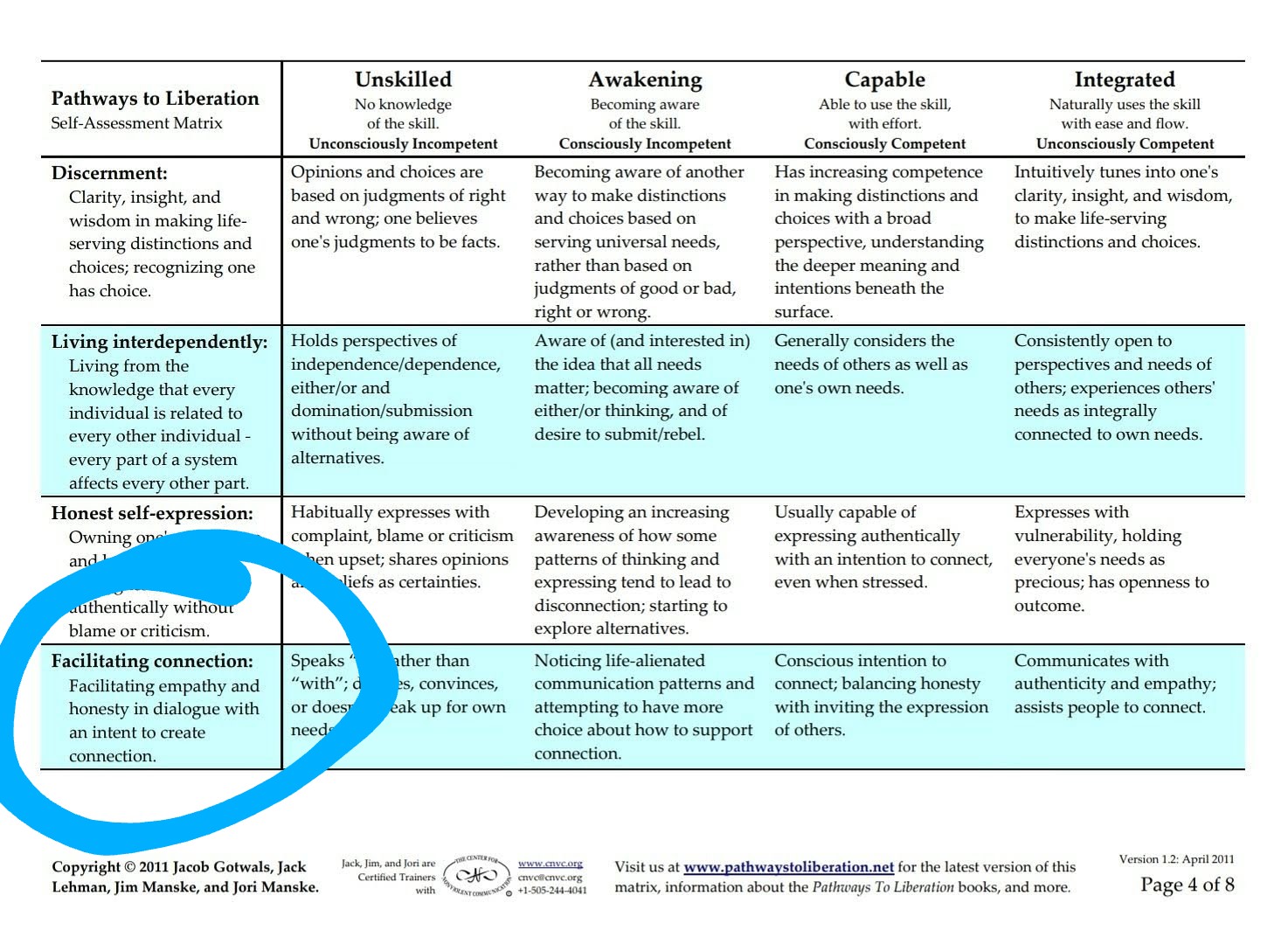
Beneath courtesy of Miki Kashtan
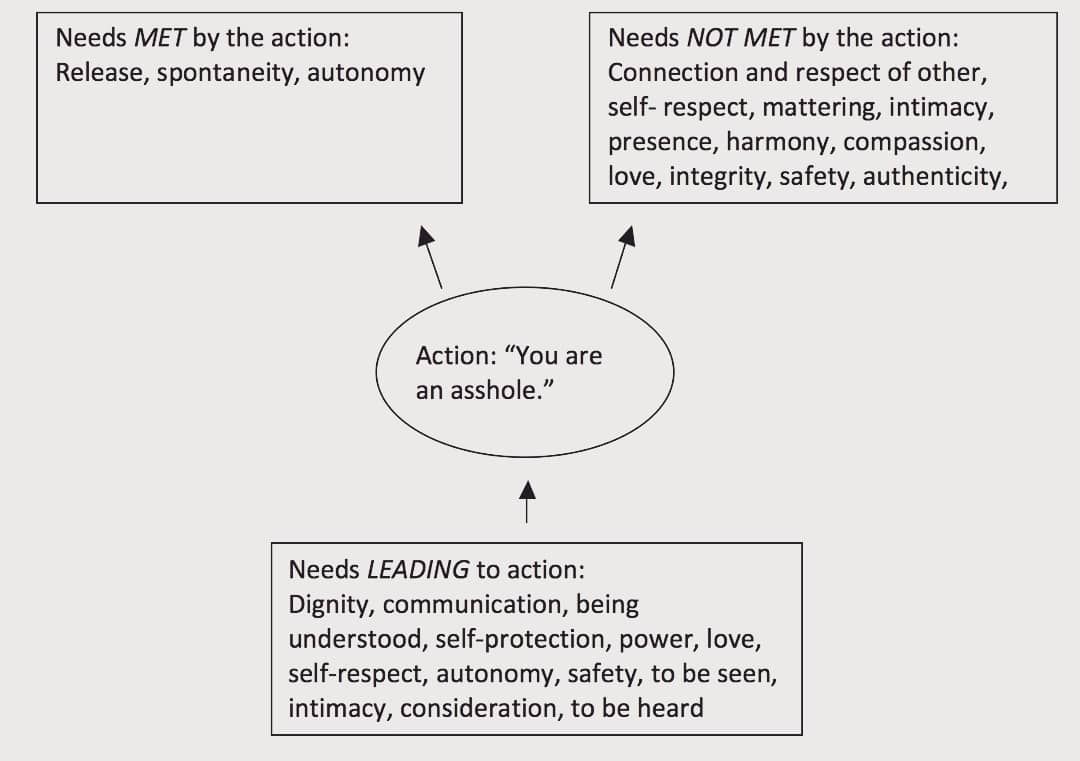
See also: 5. Use language consciously.

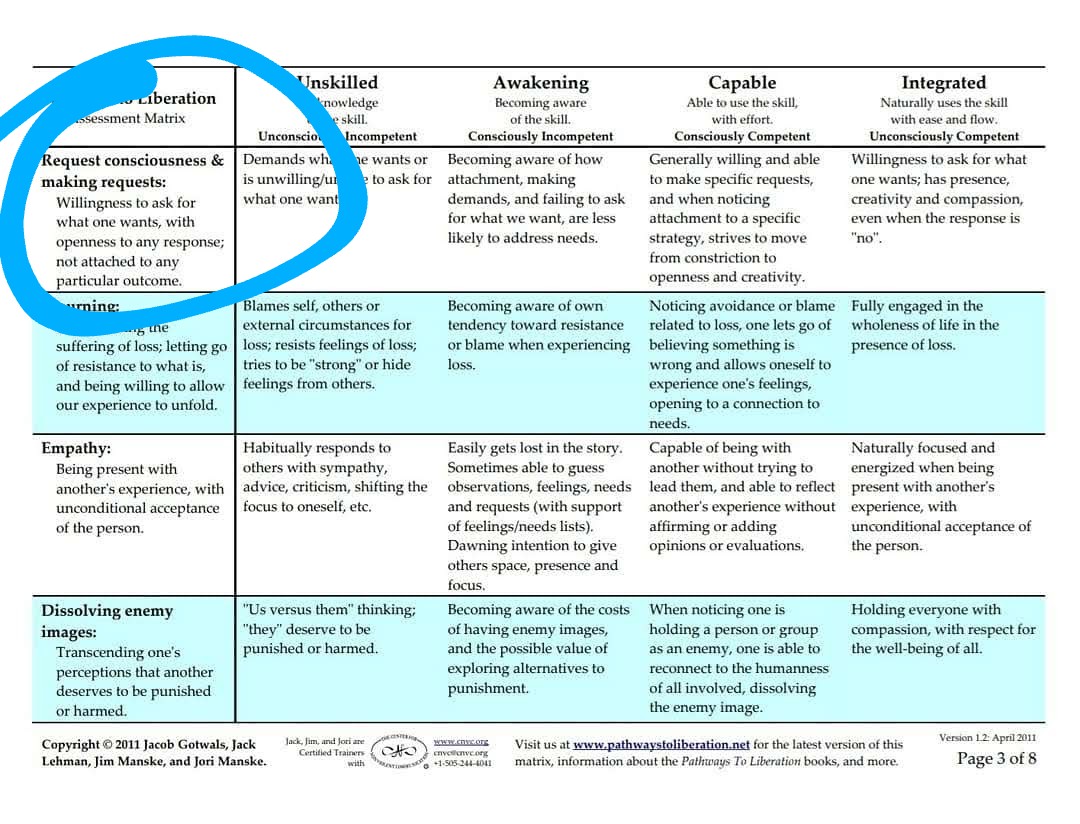
Pathways to Liberation – Self-Assessment Matrix [PDF]


More as to Nonviolence

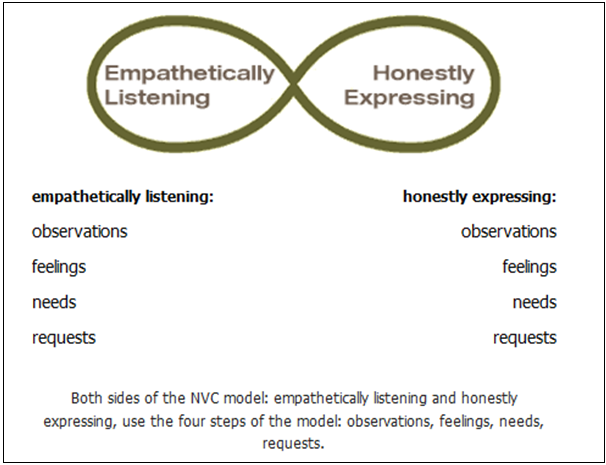
Giraffe Language and Jackal Language | Nonviolent Communication

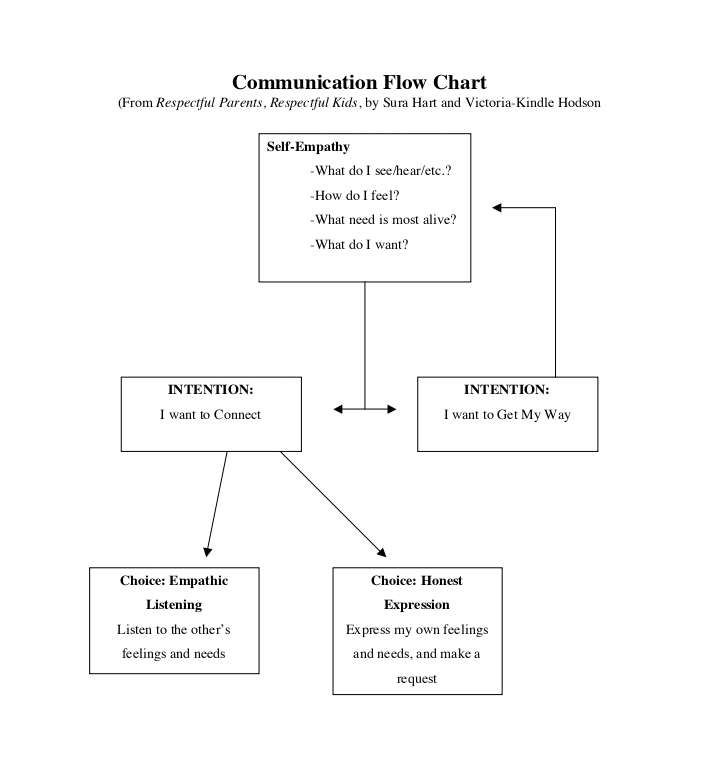
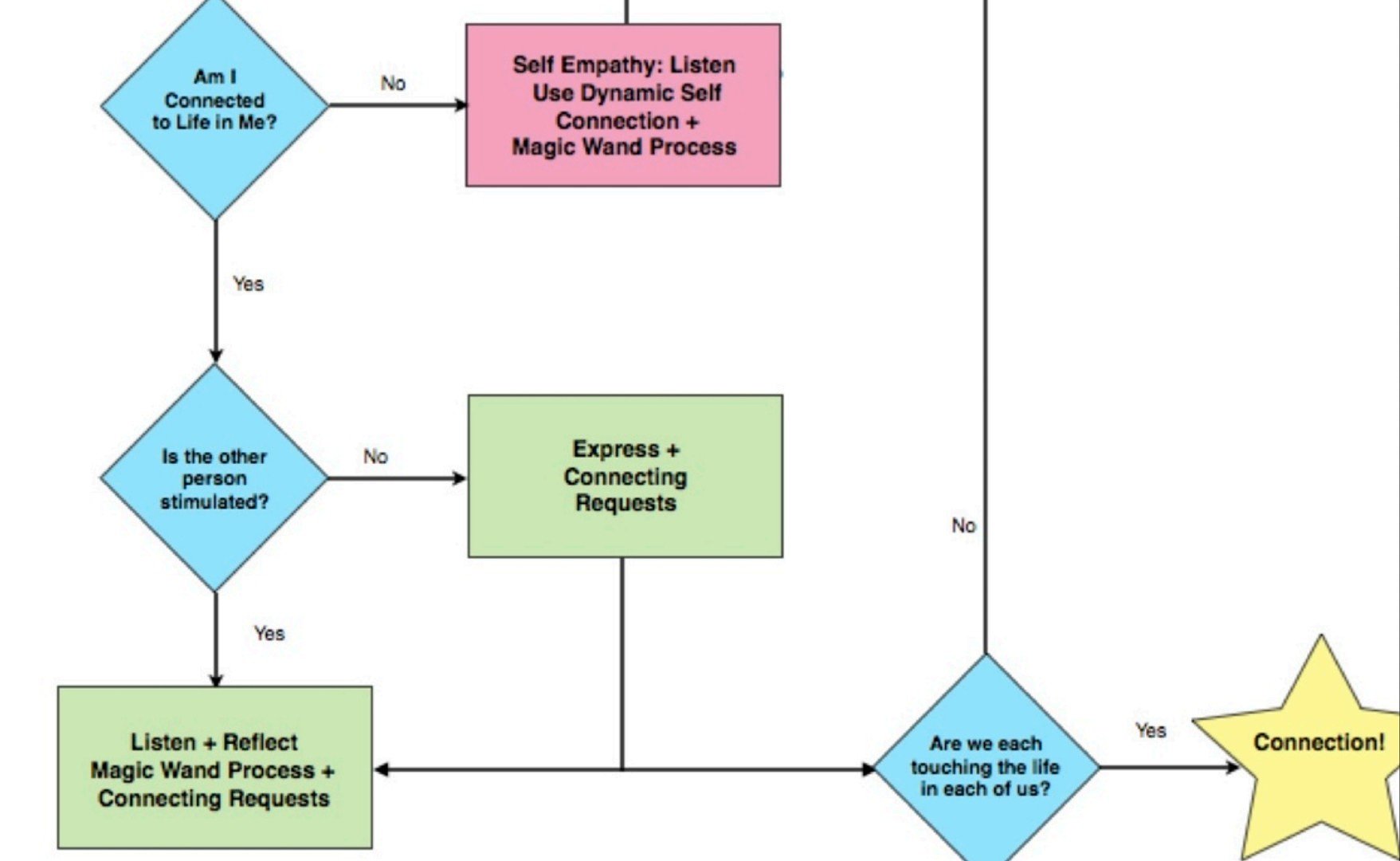
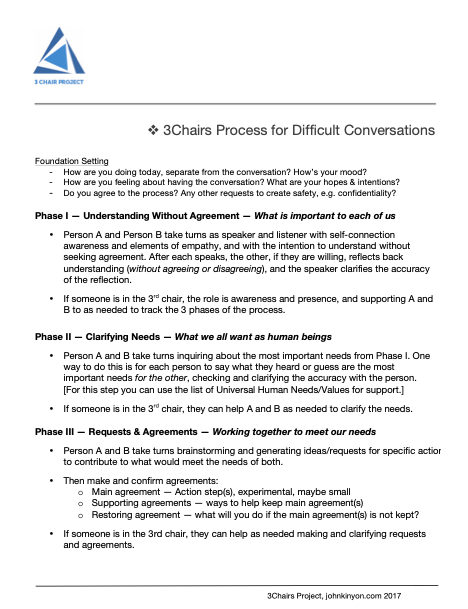
John Kinyon‘s 3Chairs Communication Flow Chart


MedioateYourLifeApp.com/resources
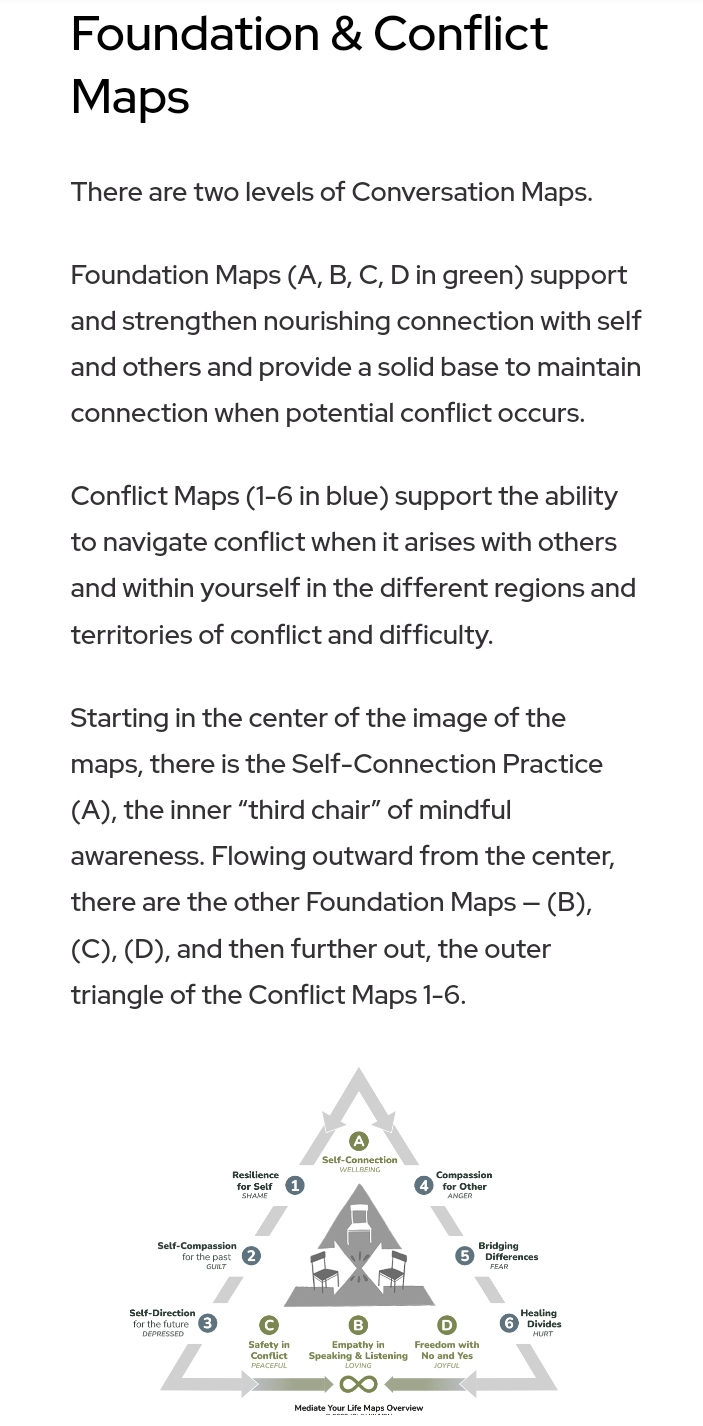
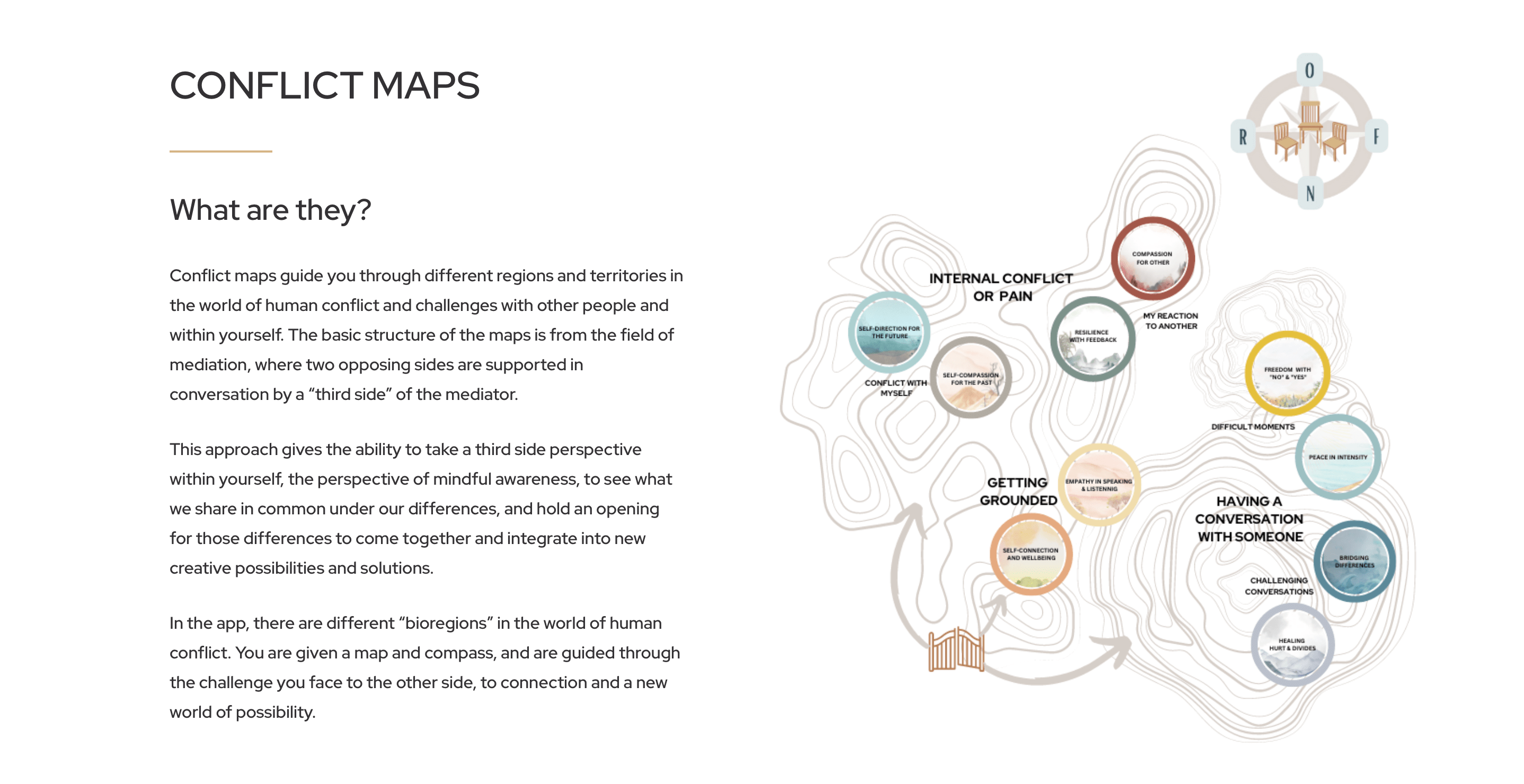
Note the lava reddened map of the enemy-imagery bio-region:

Yvette Erasmus, PsyD – YouTube
How to Deal with “Egotistical” People | YvetteErasmus (Blog post)

More blog posts here
Assessing the Health of your Relationships
Dr. Yvette Erasmus – YouTube Channel
Inner Conflict: NVC & Parts Work
When an Intrapersonal Conflict Arises (re: Past/Future Options)

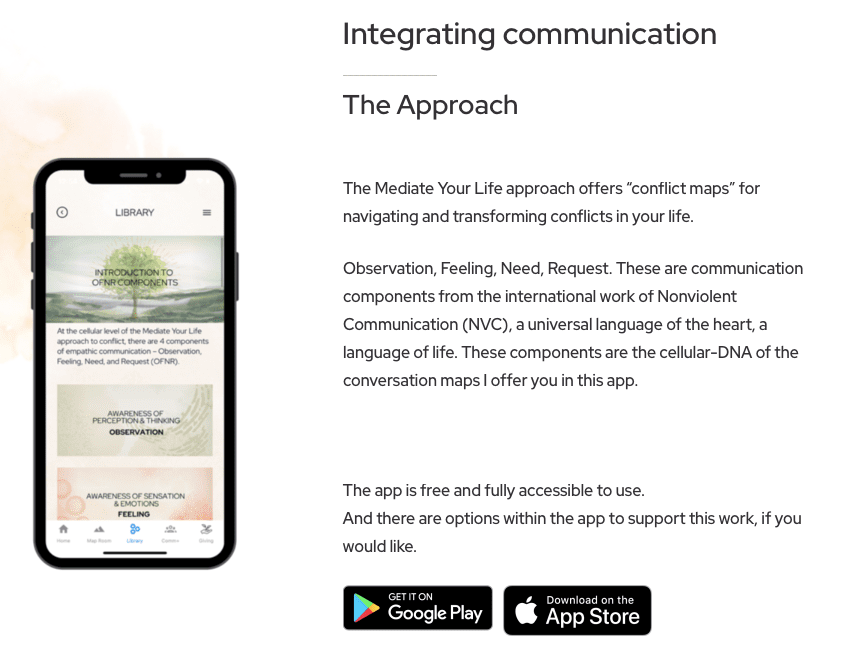
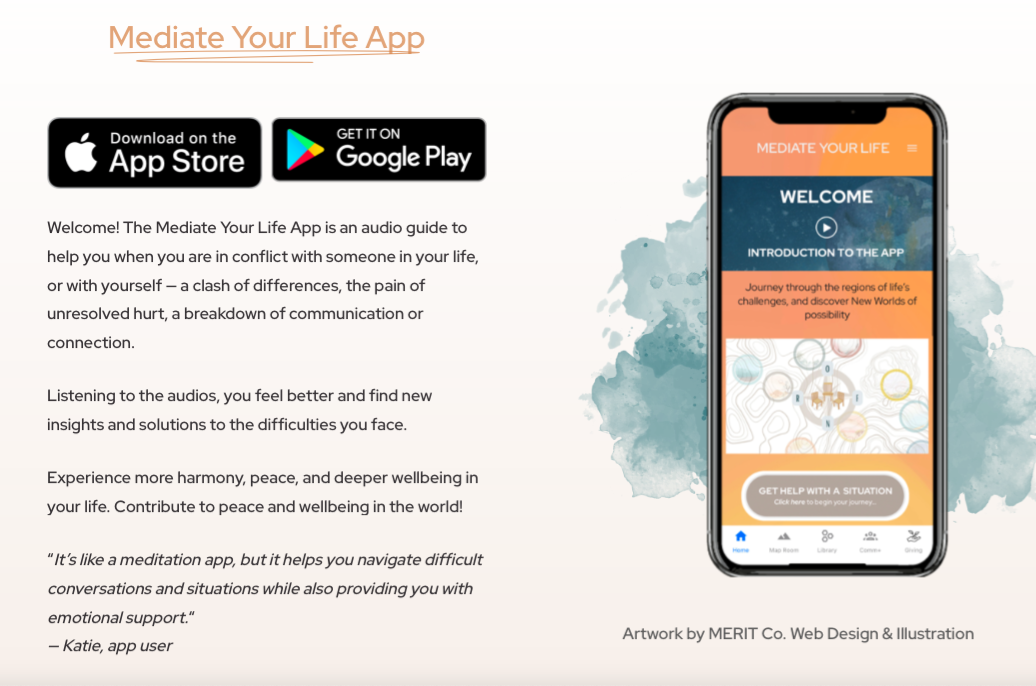
MediateYourLifeApp.com
The Mediate Your Life app is free and available to everyone who wants it.
Courtesy of John Kinyon
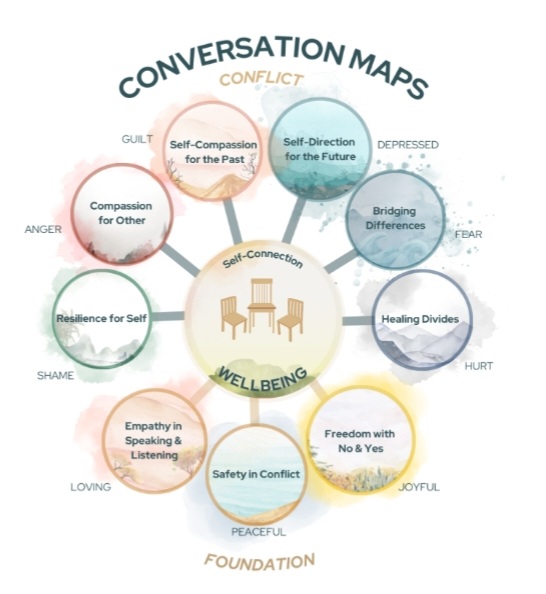
The Mediate Your Life app is free and available to everyone who wants it.
Please note the molten, lava-red — “Compassion for Other” — depicting the ‘enemy-imagery process’ (bio-region) can represent the dynamics of either an intrapersonal &/or interpersonal conflict:
MediateYourLifeApp.com/resources

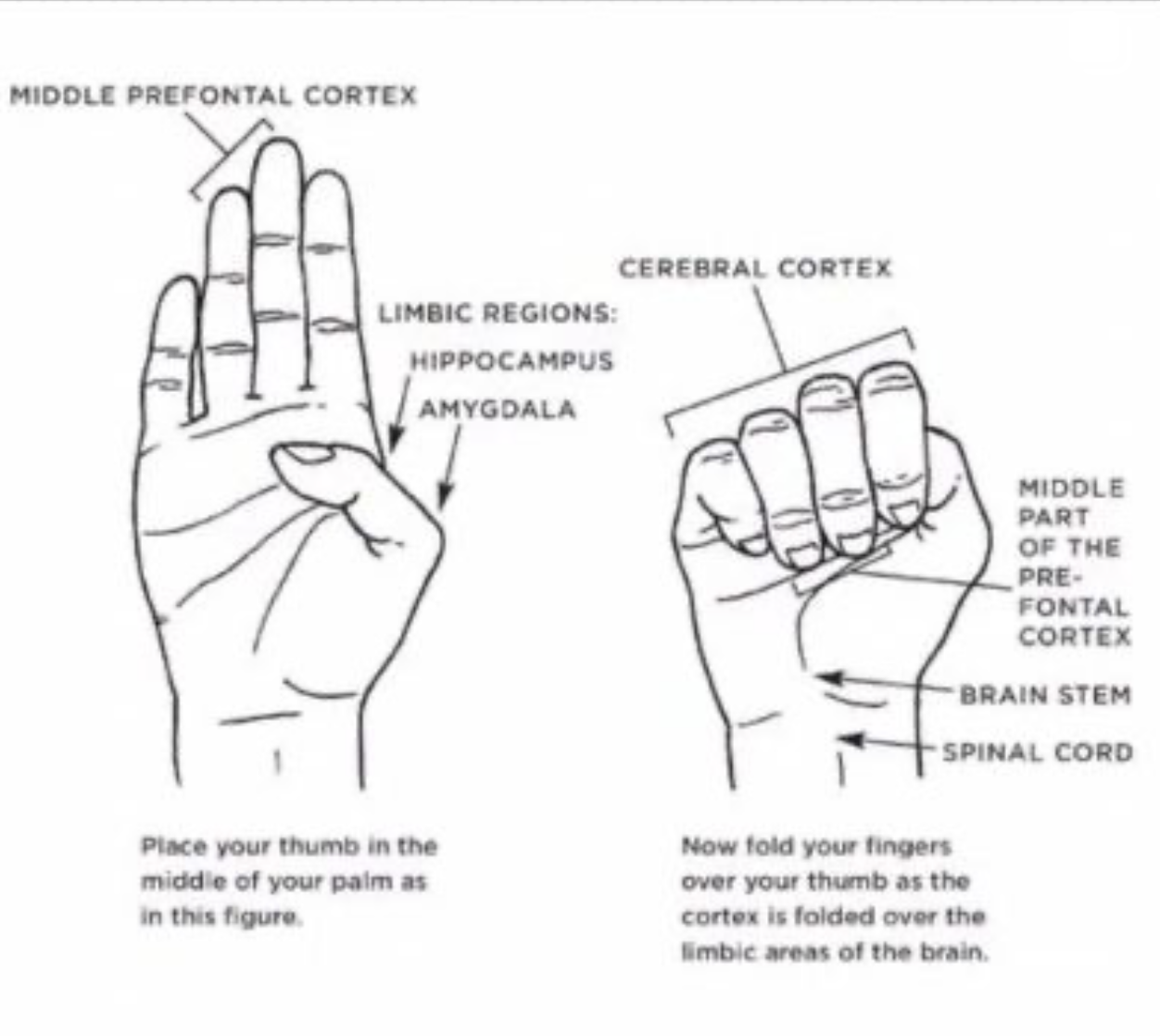
Two Beneficial Concepts — 1) Polyvagal Theory & 2) “Parts Work” (e.g. IFS/IRF) — Potentially Illuminative Towards Greater Self-Awareness
Polyvagal Theory
Parts Work:
NVC, IFS & Being “Blended” With A Part


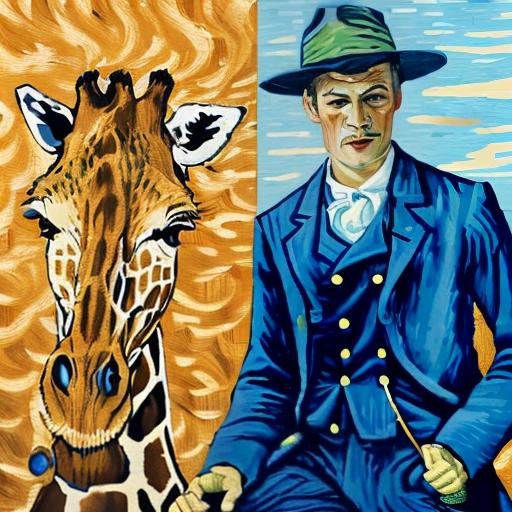
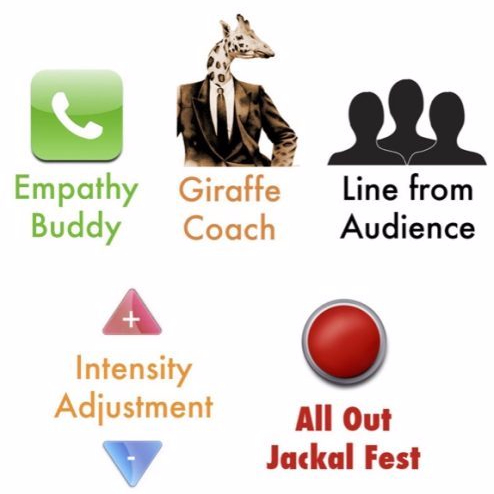
During a state in which our enemy-imagery is aroused, the giraffe can symbolize our “Self/Self-in-Presence” while the Jackal can indicate when our sympathetic “fight/flight” or dorsal “freeze” reactivity has been triggered. Ideally, when we can bring NVC consciousness (a.k.a. giraffe/self-energy) to bear it can offer greater spaciousness to observe and accompany the agitation channeled by a jackal or part. However, as Stephen & Ondrea Levine once put it, “Mindfulness can be an extreme sport” (meaning, on occasion — perhaps not infrequently — we can get carried away on a roller coaster of our thoughts, feelings, habituated reactivity, etc.). This represents being activated by our physiology, wherein an awareness of the concepts of getting blended/unblended with a part, along with an apprehension of our polyvagal operating system can each serve to underwrite more navigational skillfulness.
“Ever found yourself so swamped by anxiety, anger, or self-doubt that it practically becomes your entire identity? 😵💫 Instead of saying, “A part of me feels angry,” you say, “I am furious!”—as if you’re wearing anger like a full-body costume. 🧥🔥 In Internal Family Systems (IFS), that’s called blending: when a Part gets so triggered it overshadows your calm, wise Self…” (continues)


See also: Dialogue-Prep & Connected-Conversation
Free NVC Academy Learning Resources
NVC Academy Account / Library subscription (required):
Healing and Reconciliation (7 Session Course)
Inner Maps of Conflict with John Kinyon:
“In this brief audio segment, John Kinyon offers a guided tour of our inner maps of conflict, including interpersonal mediation, chooser/educator, enemy images and making amends maps.”
NVC Academy Resources with John Kinyon
See also: Politics & NVC
See also: Shifting to Needs-Consciousness

Nonviolent Communication trainer, Francois Beausoleil, translated ahimsa as “the state of the heart that is free of enemies.”
Latest NVC Library Resources with Francois Beausoleil: The Blame-Free State (5 Session Course)

Aztec Jaguar Warrior FAMSI website courtesy of Wikimedia Commons

Transforming Enemy Images in the Workplace
By Ike Lasater with Julie Stiles
In our encounters with people in the workplace, we will inevitably find judgments arising of ourselves or others. I call these enemy images — a term I have borrowed from Marshall Rosenberg. I have an enemy image whenever I have a judgment, diagnosis, or analysis of someone else or myself.
I like to work with enemy images because I do not like how I feel going about my daily life when I have them, or how I act when I’m thinking in enemy images and experiencing the feelings that are consistent with those thoughts.
These are examples of enemy images:
- She does not care.
- He is aggressive.
- They are out to get me.
- She is really smart.
- He is better than me.
- I screwed up.
- I am great.
- He is crazy.
All of these statements have a commonality — they put yourself or others into a static box labeled with who or what they are.
The two main problems with enemy images are that they dehumanize and they tend to create exactly what I don’t want.
By dehumanize, I mean that any time we label someone in a static way, we limit their full humanity and then tend to interact with them out of this diminished idea of who they are. In doing so, we often find our expectations are borne out. For instance, if you go into a meeting with the expectation of a hostile reception, you will likely act and speak in ways that increase the likelihood that you will be received in the way you fear.
Now, you might be thinking, “So what if I think my boss is a jerk? As long as I don’t say or do anything to act on the thought, it doesn’t matter.”
In my experience, however, it matters a lot. In the mediation work that I do, when I have a judgment in my head, I can see disconnection beginning to happen in the room within moments. Whenever a person has a thought that they do not consciously disbelieve, their neurological system will release neurotransmitters that are consistent with that thought. Thus, our thoughts affect our feeling state, which in turn affects our micromovements, the rhythm of our speech, the words we choose, and the energy with which we deliver them. All of that together communicates on an unconscious level.
The Enemy Image Process
Once we are clear that we want to work with enemy images, the process is similar to other NVC processes. The first step is awareness: to realize that I have such judgments.
The idea behind the enemy image process is that if I’m having a judgment, it is an expression of unmet needs. In doing this process, I shift to evaluating whether my needs are met or not. If I can translate the judgment into the needs not met, I will have tapped into the power of the mind, once directed to what is desired, to diligently search for strategies that will meet my needs.
Self-empathy and silent empathy are the central components to the enemy image process. I get my need for empathy met by identifying the need or needs that I’m seeking to meet by making a judgment.
This is not an analytical process; instead, ask the question gently, perhaps with a list of needs in front of you. In a musing frame of mind, query yourself as to whether it might be this need or that need. This is typically an iterative process in which the self-inquiry is repeated over and over again; with each response, you use changes in your felt sense to guide you in further guesses as to what the need might be.
If I’m having a judgment of somebody else, then I practice silent empathy, which shifts the focus of my attention onto the needs of the other person by guessing what needs they might be seeking to meet by the conduct that I am judging. I do not have to be “right” about my guesses; the important thing is that I focus my attention on their needs as the motivation for their conduct. I am satisfied with this part of the process when I feel a certain resonance with my guess.
Enemy Images at Work
In the workplace, the opportunity to use the enemy image process comes up frequently… (continues)
Dr. Yvette Erasmus – YouTube Channel
For more as to NVC & Social Change Agency:
Politics & NVC
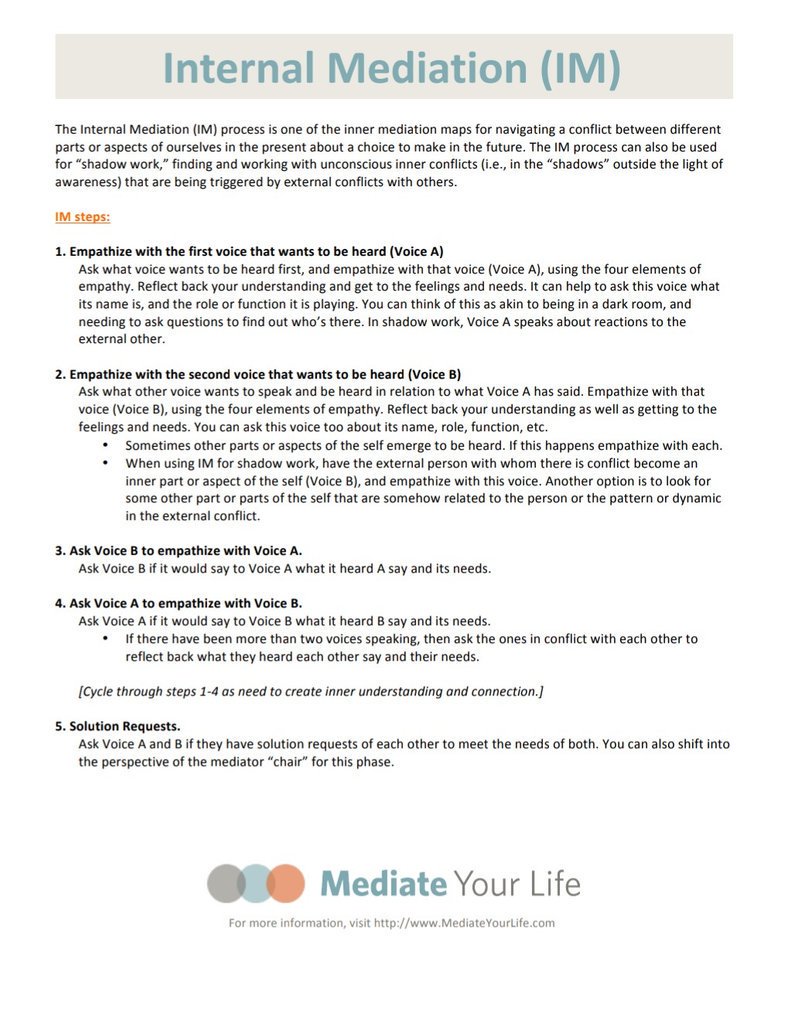
Mediate Your Life — Enemy Image Process
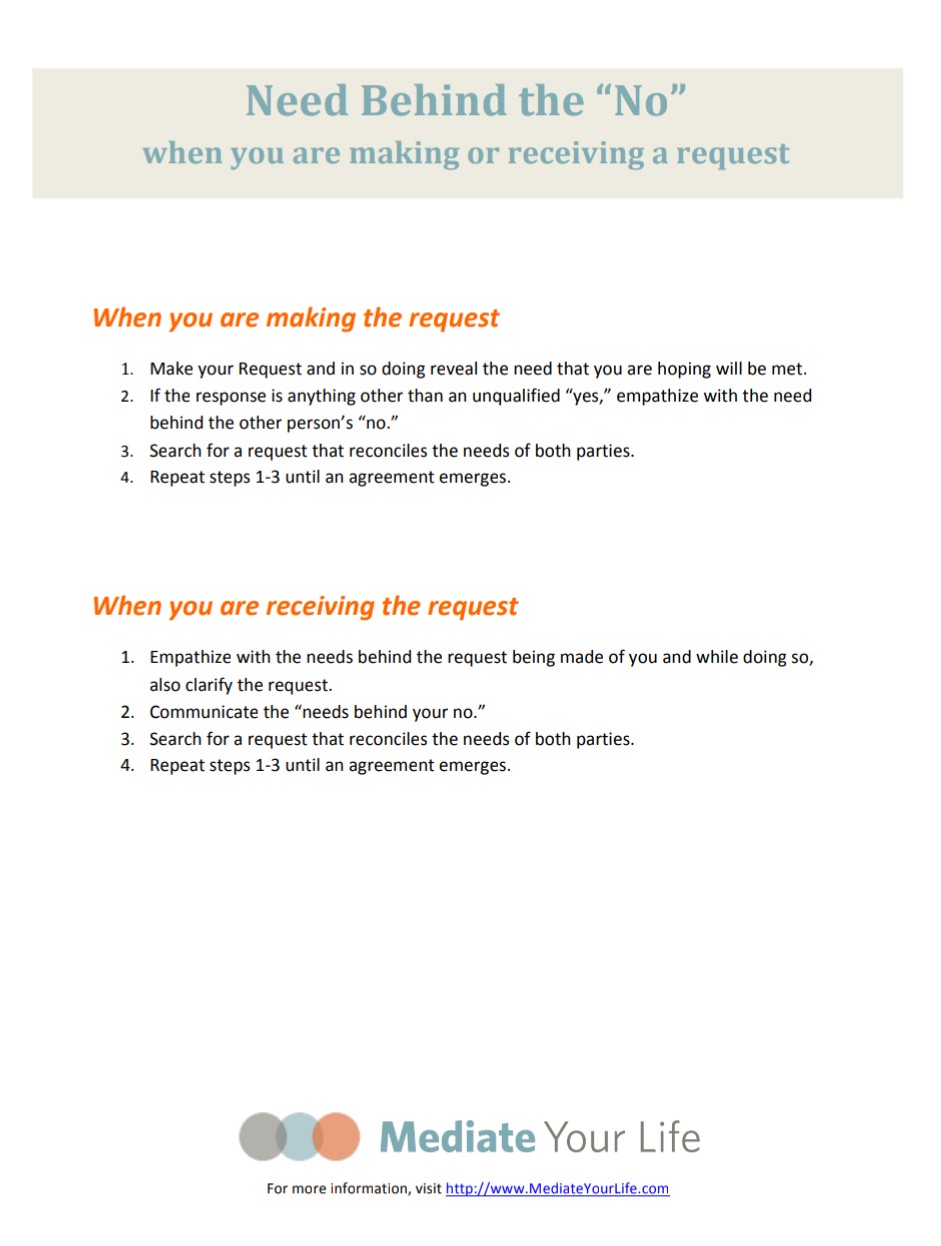
Need Behind The No Description

Sven Hartenstein’s cartoons
Transforming Enemy Images – Speak Peace in a World of Conflict
Transforming Enemy Images
Excerpted From “Speak Peace in a World of Conflict”
By Marshall B. Rosenberg, Ph.D.
In our Nonviolent Communication training and books, we want people not only to come out with awareness of how NVC can be used to transform their inner world, but also to see how it can be used to create the world outside that they want to live in.
To create the world that exemplifies our values, we need to liberate ourselves from enemy images — the thinking that says there is something wrong with the people whose actions or values we don’t agree with. Whether our enemy images are with politicians, individuals with religions convictions different from our own, leaders of the corporate world, or our neighbors next door, lasting social change isn’t possible until we learn how to transform these enemy images.
Now, that’s not easy to do. Why? Because it’s hard to believe that those who are doing things far outside of our value system are human beings like the rest of us. It’s very challenging.
Let me give you an example. I was visiting Fargo, North Dakota, to do some training in the schools. I wasn’t there to facilitate a mediation. Somebody who had helped us get into the schools asked me a personal favor.
She said, “You know, Marshall, in my family we’re having a big conflict about my father’s retirement. He wants to retire, but there’s tremendous conflict in the family between my two brothers about how my father wants to divide up our large farm. We’ve even been in the courts trying to solve this. It’s horrible. I could arrange your schedule so you could have a long lunch of two and a half hours. Would you be willing to mediate?”
I said, “You say it’s been going on for months?” She said, “Actually years, and I know it’s over lunchtime, Marshall, but whatever you could do to help, I would really appreciate it.”
So I went into the room that day with the father and the brothers. Incidentally, the father lived in the middle of the farm, and each son lived on one end. The brothers hadn’t spoken to each other in eight years! I asked the usual question to the brothers: “Could you tell me what your needs are?”
The younger brother suddenly screamed at his older brother, “You know, you’ve never been fair to me. You and Dad only care about each other. You’ve never cared about me.”
Then the older brother said, “Well, you never did the work.”
And so they were yelling at each other for about two minutes. I didn’t need to hear more about the background. In that short amount of time, I could guess what each side’s needs were that weren’t being addressed or understood.
Because I was pressed for time, I said to the older brother, “Excuse me. Could I play your role for a moment?” He looked a little puzzled, but he shrugged and said, “Go ahead.”
So I played his role as though he had Nonviolent Communication skills. I was able to hear behind the younger brother’s judgmental way of expressing himself what his needs were that weren’t met. And I’d heard enough of the older brother’s needs by then to express his needs in a different way. And we made a lot of progress in helping the brothers see each other’s needs. However, the two and a half hours were up, and I had to go back and do my workshop.
The next morning, the father — who, as I noted, had been sitting in on the session — came to where I was working with the teachers. He was waiting for me out in the hall. He had tears in his eyes, and he said, “Thank you so much for what you did yesterday. We all went out to dinner last night for the first time in eight years, and we resolved the conflict over dinner.”
See? Once both sides get over the enemy image and recognize each other’s needs, it’s amazing how the next part, which is looking for strategies to meet everyone’s needs, becomes pretty easy by comparison. It’s getting past the enemy images; that’s the hard work.
It’s getting people to see that you can’t benefit at other people’s expense. Once you have that clear even complicated things like family squabbles aren’t horrible to resolve because you’ve got people connecting at a human level.
The same thing applies to any situation where you have seemingly opposing values. The most common elements I’ve found in the conflicts I’ve been asked to mediate are that people — instead of knowing how to say clearly what their needs and requests are — are quite eloquent in diagnosing other people’s pathology: what’s wrong with them for behaving as they do.
Whether it’s two individuals, two groups, or two countries that have conflicts, they begin the discussion with enemy images, telling the other person what’s wrong with them. The divorce courts — and the bombs — are never far away.
Marshall B. Rosenberg, Ph.D. is the author of Nonviolent Communication: A Language of Life, Speak Peace in a World of Conflict, Life-Enriching Education, and dozens of booklets, videos and audiotape series. He is the founder and educational director of the Center for Nonviolent Communication, and spends over 200 days each year teaching NVC throughout the world.

NVC: Dealing with Enemy Images
François Beausoleil — Dissolving Enemy Images
Francois Beausoleil (Author of The Blame-Free State Vol. 1) | Goodreads
Exercise: Dissolving enemy images | The Center for Collaborative Communication
by CCC partner trainer and CNVC Certified Trainer François Beausoleil
Enemy images are fixed ideas we create about others that come from a judgment of them, which often lead to blocks in our ability to empathize or connect with that person.
Often the ones we care about most can inspire us the most judgment and disconnection.
Here is an exercise from Francois Beausoleil, CNVC Certified Trainer and life coach, and how to help you translate some of your fiercest judgments of others into understanding and connection. Try this exercise either in your mind, or writing down the answers on a piece of paper or in your journal.
– Precise observation on an action taken by the person of which you have an enemy image (example: the person with whom you do ride-sharing arrived at least 10 minutes after the agreed time three times last week)
– Your feelings related to the observation(s) (example: I felt frustrated and stressed)
– Your needs related to these feelings (example: I’m mourning not having the peace of mind and efficiency I wanted)
– Feelings possibly present for the person (example: maybe he was stressed and overwhelmed)
– Needs related to the person’s possible feelings (example: something around wanting ease)
– Could there be a misunderstanding (example: maybe he thinks I’m flexible)
– Are you giving any meaning to the observations (example: it might mean that I will lose my job if I continue to arrive late)
– If so, is this (or these) meaning(s) necessarily true?
– Imagine a scenario that would lead you to have as close to no blame at all for the person (example: his wife just left him and he’s struggling to adapt his schedule since he’s taking care of their 2 kids one every other week)
Nonviolent Communication trainer, Francois Beausoleil, translates ahimsa as “the state of the heart that is free of enemies.”
See also: also: Dialogue Prep

Via Twitter:
(beneath via link MediateYourLifeApp.com/resources)
See also:


Cartoon above courtesy of HeartheNeed.com





















































































 Street Giraffes